
September 2, 2026
Pallet Wrapper Maintenance
A fully automatic pallet wrapping machine is an essential component for any high-volume warehouse or business. It can wrap pallets without any operator involvement, automatically wrapping and cutting the stretch film to ensure precise performance.
Maintenance is essential to the performance and longevity of these machines and may need to be carried out by businesses on a daily, weekly and monthly/yearly basis. The maintenance steps range from checking the various components for any sign of wear and tear, applying lubrication and organising for a professional inspection to identify any potential issues with your machine. Carrying out these steps on a consistent schedule can extend the lifespan of your pallet wrapper, reducing unplanned downtime and improving worker safety.
Why Preventative Maintenance is Important
Preventative maintenance is a vital part of protecting packaging machinery from unexpected breakdowns and prolonging its lifespan. Especially for pallet wrappers, which are under consistent strain, preventative maintenance is essential for the following reasons:
- Lower repair costs – Preventative maintenance can ensure you catch any potential issues early, saving you time and money by ensuring they don’t snowball into more catastrophic, expensive failures.
- Reduced unplanned downtime – Regular maintenance checks can improve the overall reliability of pallet wrappers to prevent any emergency breakdowns or shutdowns from affecting productivity.
- Improve worker safety – Maintenance checks help to detect any potential faults early, reducing the possibility of any worker accidents or injuries. Pallet wrappers in particular handle massive loads and operate under high mechanical tension, with preventative maintenance reducing the risk of structural failures or unstable pallet tip-overs.
- Extend machine lifespan – Pallet wrappers can be significant investments, with preventative maintenance allowing your machine to run longer and reach its expected lifespan without major breakdowns.
- Maintain consistent quality – A pallet wrapper that’s well-maintained is more likely to run efficiently and wrap pallets more consistently. When maintenance is not carried out, worn rollers may cause the film to snap or apply a loose wrap that affects production quality.
- Expert technical advice – Expert technical advice can support your preventive maintenance, helping you understand what needs to be monitored and when repairs are required. At Contract Packaging Systems (CPS), we have extensive knowledge in SIAT pallet wrappers, including their key maintenance steps and extra support if you run into any issues.
Pallet Wrapper Components That Require Maintenance
Preventative maintenance should be targeted around the key components of a pallet wrapper. These include:
Mechanical components
- Motor and gearboxes – The motor and gearbox are critical components of a pallet wrapping machine. They are responsible for driving the turntable or rotary arm and require lubrication and seal checks to prevent overheating.
- Turntable rollers – They support the weight of the heavy pallets and turntable as it rotates and allow it to spin smoothly beneath the load.
- Chains and belts – These components drive the lift and rotation mechanisms, transferring the power from the motor to the moving parts of the machine.
- Bearings – Bearings reduce the friction between all the moving parts of a pallet wrapper, allowing the components like the turntable and rollers to rotate freely when under load.
Film delivery system
- Pre-stretch rollers – These rollers stretch the film before it’s applied to the load and must be cleaned weekly to remove any sticky residue and to maintain proper tension.
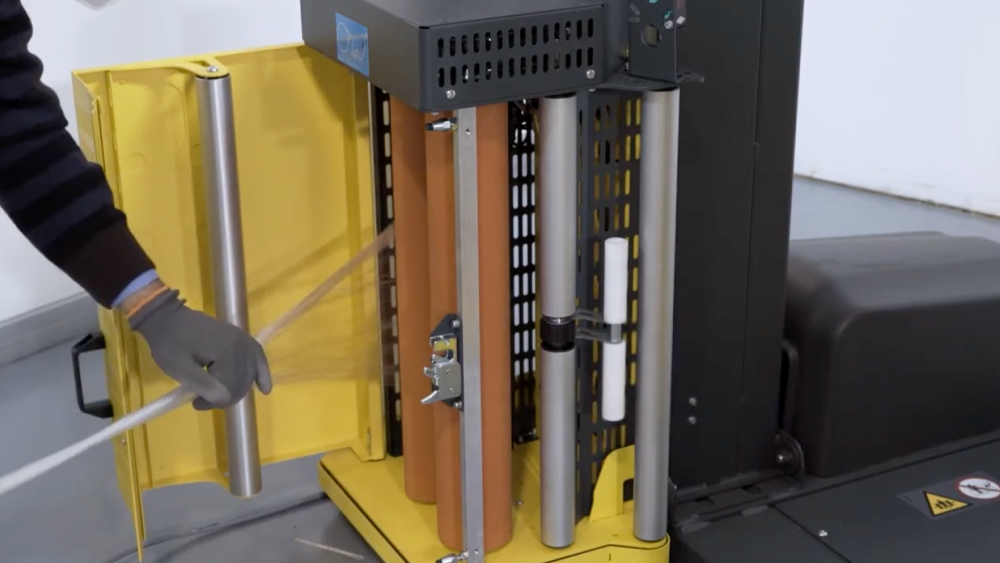
- Film carriage – The film carriage is responsible for holding the film roll and pre-stretch rollers. It moves vertically up and down the mast to wrap the load from the base to the top.
Electrical components
- Sensors – Sensors on a pallet wrapper machine can detect load height, film tension and turntable position so the machine can automatically adjust the wrapping.
- Wiring – Wiring connects all the electrical components together, including the control panel, sensors and motor, to achieve smooth operation.
How to Create a Pallet Wrapper Maintenance Schedule
Businesses will have slightly different maintenance schedules depending on a range of factors. These include:
- Machine usage – If your pallet wrapper is being run consistently, then you will need a maintenance schedule that is much more frequent to keep up with the heavy use. On the other hand, a pallet wrapper that’s used sparingly won’t need as much attention.
- Operating environment – Certain operating environments will generally add more wear and tear to a packaging machine. If your pallet wrapper is being used outside, with high temperatures or dust, you will require more cleaning and maintenance checks to avoid any issues.
- Machine age – As a pallet wrapper ages, the more likely it is to run into problems or break down. Therefore, an older pallet wrapper will naturally require a more intensive maintenance schedule than brand-new equipment.
- Manufacturer/supplier recommendations – Always check your original equipment manufacturer’s (OEM) user manual as the starting point for creating a maintenance schedule. These manuals will often specify the exact lubrication and servicing intervals to maximise your pallet wrapper’s performance.
Pallet Wrapper Maintenance Schedule
To give you an idea of the expected maintenance schedule, the following table is a sample of how often you should service your pallet wrapper and the types of tasks you should carry out:
| Frequency | Responsibility | Main tasks |
| Daily | Equipment operator | Visual inspections, clean machine, check film carriage |
| Weekly | Equipment operator | Clean debris, inspect chains, rollers and belts |
| Monthly | Maintenance staff | Lubrication, tighten fasteners and inspect for wear |
| Periodic servicing | Professional technician | Full professional servicing, calibration, replace any worn components |
Importantly, this table should be treated purely as a sample guide. The exact frequency will depend on the intervals recommended by your manufacturer.
The types of maintenance tasks you’ll perform on your pallet wrapper will also be different depending on the frequency. The following are some of the steps involved for preventive maintenance to ensure your pallet wrapper performs reliably long-term:
Daily
- Remove debris – Turn the machine off and sweep or blow away any dust and packaging debris from around the turntable base and film carriage.
- Check film roll – Inspect the film roll for tears and punctures. Also check if the film roll is low and re-stock it if there’s not enough to complete the next few wraps.
- Check for unusual noises – We recommend running the machine through a test cycle and listening out for unusual noises, such as grinding, squeaking or knocking. If you encounter any unusual noises, make a record so it can be investigated before it gets worse.
Weekly
- Clean underneath turntable – Turn the machine off and inspect the area underneath the turntable for any accessible dirt or debris. Follow the manufacturer’s instructions closely if any deeper cleaning is required.
- Inspect chains – Examine the chains for any signs of rust or dryness. When you encounter dry spots or signs of stiffness, we recommend applying an all-purpose grease.
- Rollers and belts – Check the belts for any wear and spin the rollers to check they move freely and there’s nothing restricting movement.
Monthly
- Lubrication – Apply a lubrication directly to the bearings, chains and other moving parts to reduce friction and prevent any premature wear and tear.
- Tighten fasteners – Regular use of a pallet wrapper may gradually loosen bolts, so it’s always worth checking in and tightening these on a monthly basis.
- Inspect for wear – Try to take a close look at all the key components such as rollers, bearings and the film carriage for signs of wear. This allows you to identify any components that may be approaching the end of their service lifespan.
Periodic servicing – depending on manufacturer guidance
- Full professional service – It’s important to book a qualified technician to carry out a full inspection of all your pallet wrapper’s mechanical, electrical and structural components. They are trained to identify areas that simple maintenance tasks can’t cover, checking for any potential problems before they affect productivity. Contract Packaging Systems (CPS) provides expert servicing and support across Australia and New Zealand, with a team of dedicated senior technicians. Visit our service page here to find out more.
- Calibration – Your technician will test and calibrate your electrical sensors and your settings to ensure the machine is performing as accurately as possible.
- Replace worn parts – Any components that your technician identifies during the inspection should be promptly replaced as recommended to reduce the risk of breakdowns before the next service.
Pallet Wrapper Maintenance Guide
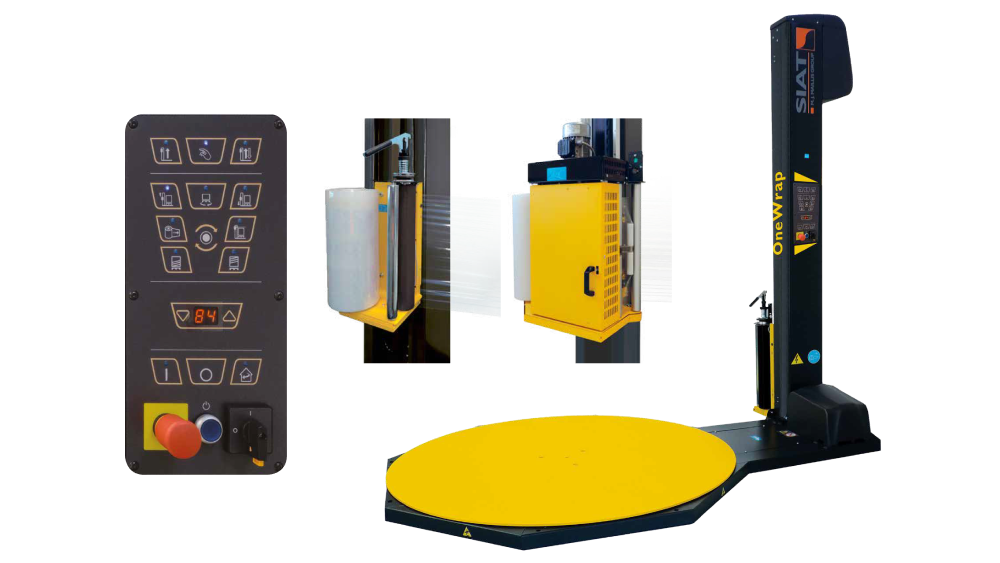
Below you’ll find a sample maintenance guide for the SIAT ONEWRAP Semi-Automatic Pallet Wrapper:
Maintenance Schedule
Every 40 work hours (max 1 week)
| Component | Operation required | Procedures to implement |
|---|---|---|
| Reel holding carriage sliding guides | Cleaning | – Remove any impurities with a plastic scraper. – Clean with a soft cloth soaked in a non-flammable and non-corrosive detergent. – Properly dry the surfaces. |
| Pallet detection photocell | Cleaning | – Clean the detection area of the photocell. – Use a clean, dry (not abrasive) cloth. |
| Lifting belt for the reel holding carriage | Wear and tear control | – Check this component for wear. Replace the component, if it is worn out (See “Replacing the lifting belt of the carriage”). |
Every 2000 work hours (max 6 months)
| Component | Operation required | Procedures to implement |
|---|---|---|
| Rotating platform rotation chain | Checking the tension | – Check the tension of component. – Adjust tension as required if necessary (See “Adjustment of chain controlling the rotation of platform”). |
| Rotating platform rotation chain | Lubrication | – Lubricate all the greasing points (See “Diagram of the points of lubrication”). |
Every 5000 work hours (max 12 months)
| Component | Operation required | Procedures to implement |
|---|---|---|
| Wheels of rotating platform | Wear and tear control | – Check this component for wear. – Replace the component, if it is worn out. |
| Vertical conveyor rollers of the reel holding carriage | Wear and tear control | – Check this component for wear. – Replace the component, if it is worn out. |
Source: https://conpack.com.au/manual/OneWrapManual2016.pdf
Find the manual unique to your pallet wrapper here, or contact the manufacturer directly for support.
Common Pallet Wrapper Problems and Troubleshooting
While preventative maintenance can put your pallet wrapper in good stead, unexpected problems can still arise. Although many of these issues can be solved in-house, it’s important to contact a professional if any of these issues can’t be resolved by routine adjustments or maintenance. The team at Contract Packaging Systems (CPS) can provide the valuable support you need. The following are some of the common pallet wrapper issues and the steps for troubleshooting:
- Film breaks frequently – This fault can be often caused by tension settings that are too high, damaged film rolls or sharp corners around the pallet load. First, check the film roll for any punctures and ensure the rollers are fully clean and free from any debris. Also try reducing the tension settings to see if that prevents the film from breaking.
- Film won’t stretch correctly – When the film isn’t stretching properly, this could be due to dirty, worn-out stretch rollers or an incorrect gear ratio setting. To solve this issue, we recommend cleaning the rollers for extra grip, in addition to checking the roller gap and speed settings against any manufacturer specifications.
- Turntable won’t rotate – When the turntable’s stationary and struggles to rotate, this is usually due to a broken drive belt or debris jammed under the platform. First, double-check that the emergency stop button isn’t turned on and inspect the chain or belt for any signs of damage or debris.
- Machine stops unexpectedly – When your pallet wrapper stops unexpectedly, this could point to a range of potential issues. The most common are usually linked to loose electrical connections, tripped safety switches or your machine detecting an issue such as a misaligned photo-eye sensor. We recommend checking the electrical cables for any damage, as well as checking the sensors for any dirt or misalignment.
- Load instability – If a pallet load is consistently unstable, this is usually due to incorrect wrap parameters, such as having too few wraps at the bottom or low film tension. Review your tension and overlap settings on your pallet wrapper and make any necessary adjustments. If it’s still unstable, it’s best to contact the manufacturer directly for advice.
FAQs
Signs that pallet wrapper needs servicing
- There are a number of signs that indicate a pallet wrapper may need servicing, including frequent film tearing, any unusual noises, loose wrapping or inconsistent wrapping quality. Reporting any of these potential signs is essential to catching issues early.
What safety steps must be carried out before maintenance?
- Safety should be non-negotiable when handling any packaging machinery such as a pallet wrapper. Prior to carrying out the necessary maintenance steps, it’s important that the machine is fully isolated and disconnected from its main power source. The film carriage must be lowered completely to the ground, with any loose plastic or debris surrounding the pallet wrapper cleared away. Operators must also ensure they follow the correct use of personal protective equipment (PPE) when carrying out these steps.
How much does servicing cost?
- The exact cost of a professional service will vary depending on the type of pallet wrapper model and the complexity of the service.
Contract Packaging Systems is Australia’s premier specialist for packaging machinery. We have unrivalled expertise in the market and can ensure the successful installation of pallet wrappers for your business. If you need support with maintenance, don’t hesitate to reach out to our friendly team.
